First programs in wxWidgets
last modified July 14, 2026
In this chapter, we cover the basics needed to create wxWidgets applications. We create our first simple example, show how to display an icon. Next we create a simple example demonstrating usage of an event. Finally, we see how widgets communicate in wxWidgets applications.
A simple application
First we create the very basic wxWidgets program.
#include <wx/wx.h>

class Simple : public wxFrame
{
public:
    Simple(const wxString& title);

};
The Simple class is derived from wxFrame. It represents
the main window of the application and declares a constructor that takes a
title string as parameter.
#include "simple.h"

Simple::Simple(const wxString& title)
       : wxFrame(NULL, wxID_ANY, title, wxDefaultPosition, wxSize(450, 350))
{
  Centre();
}
The constructor passes the title to the wxFrame base class,
sets the initial window size to 450 by 350 pixels, and centers the window
on the screen with the Centre method.
#include <wx/wx.h>

class MyApp : public wxApp
{
  public:
    virtual bool OnInit();
};
The MyApp class is derived from wxApp and overrides
the OnInit virtual method, which is called when the application
starts up.
#include "main.h"
#include "simple.h"

IMPLEMENT_APP(MyApp)

bool MyApp::OnInit()
{
    Simple *simple = new Simple(wxT("Simple"));
    simple->Show(true);

    return true;
}
The IMPLEMENT_APP macro generates the application entry point.
Inside OnInit, we create an instance of Simple on
the heap and show it by calling Show(true).
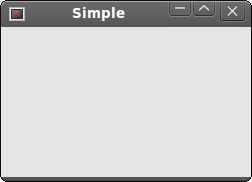
This very basic example shows a small window on the screen. The window is centered.
Centre();
This method centers the window on the screen, both horizontally and vertically.
IMPLEMENT_APP(MyApp)
The code that implements the application is hidden behind this macro. This is copy and paste code, we usually do not have to care about.
g++ main.cpp main.h simple.cpp simple.h `wx-config --cxxflags --libs` -o simple
To compile the example on Unix, run the above command.
Application icon
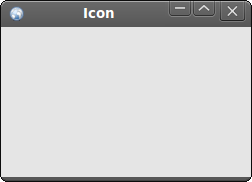
In this example, we provide an icon for our application. It became a standard to display a small icon in the upper left corner of the window. The icon is a graphical identity of the program.
#include <wx/wx.h>

class Icon : public wxFrame
{
public:
    Icon(const wxString& title);

};
The Icon class is derived from wxFrame and provides
a constructor that accepts the window title. It will display a custom icon
in the title bar.
#include "icon.h"

Icon::Icon(const wxString& title)
       : wxFrame(NULL, wxID_ANY, title, wxDefaultPosition, wxSize(450, 350))
{
  SetIcon(wxIcon(wxT("web.xpm")));
  Centre();
}
The constructor sets an application icon by loading the web.xpm
file via SetIcon and then centers the window on the screen.
XPM (X PixMap) is an ASCII image format.
#include <wx/wx.h>

class MyApp : public wxApp
{
  public:
    virtual bool OnInit();
};
The MyApp class serves as the application object. The
OnInit method is the entry point where we instantiate the
main frame.
#include "main.h"
#include "icon.h"

IMPLEMENT_APP(MyApp)

bool MyApp::OnInit()
{
    Icon *icon = new Icon(wxT("Icon"));
    icon->Show(true);

    return true;
}
The OnInit method creates a new Icon frame and
makes it visible. The IMPLEMENT_APP macro provides the
application startup code.
In our example we show a small web icon.
SetIcon(wxIcon(wxT("web.xpm")));
To display an application icon is a matter of one code line. XPM (X PixMap) is an ASCII image format.
A simple button
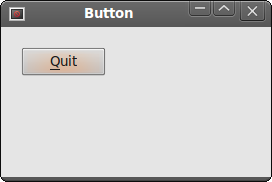
In the following example, we create a button on the frame widget. We show, how to create a simple event handler.
#include <wx/wx.h>

class Button : public wxFrame
{
public:
    Button(const wxString& title);

    void OnQuit(wxCommandEvent & event);
};
The Button class is derived from wxFrame and
declares the OnQuit event handler method that will be called
when the button is clicked.
#include "button.h"

Button::Button(const wxString& title)
       : wxFrame(NULL, wxID_ANY, title, wxDefaultPosition, wxSize(270, 150))
{
  wxPanel *panel = new wxPanel(this, wxID_ANY);

  wxButton *button = new wxButton(panel, wxID_EXIT, wxT("Quit"),
      wxPoint(20, 20));
  Connect(wxID_EXIT, wxEVT_COMMAND_BUTTON_CLICKED,
      wxCommandEventHandler(Button::OnQuit));
  button->SetFocus();
  Centre();
}

void Button::OnQuit(wxCommandEvent & WXUNUSED(event))
{
    Close(true);
}
The constructor creates a wxPanel and places a
wxButton on it. The button is connected to the
OnQuit handler using Connect. The
OnQuit method calls Close to terminate the
application.
#include <wx/wx.h>

class MyApp : public wxApp
{
  public:
    virtual bool OnInit();
};
The MyApp class defines the application object with an
OnInit method that creates and shows the main frame.
#include "main.h"
#include "button.h"

IMPLEMENT_APP(MyApp)

bool MyApp::OnInit()
{

    Button *btnapp = new Button(wxT("Button"));
    btnapp->Show(true);

    return true;
}
The OnInit method creates a Button instance and
displays it on the screen. The IMPLEMENT_APP macro bootstraps
the application.
wxPanel *panel = new wxPanel(this, wxID_ANY);
First we create a wxPanel widget. It will be placed inside
a wxFrame widget.
wxButton *button = new wxButton(panel, wxID_EXIT, wxT("Quit"), wxPoint(20, 20));
We create a wxButton widget. It is placed on the panel. We use
the predefined wxID_EXIT id for the button.
It will cause to display a small exit icon on the button. The label of
the button is "Quit". The button is positioned manually at x=20, y=20 coordinates.
The beginning of the coordinate system is at the upper left hand corner.
Connect(wxID_EXIT, wxEVT_COMMAND_BUTTON_CLICKED,
    wxCommandEventHandler(Button::OnQuit));
If we click on the button, a wxEVT_COMMAND_BUTTON_CLICKED event is
generated. We connect the event to the OnQuit method of the
Button class. So when we click on the button, the OnQuit
method is called.
button->SetFocus();
We set the keyboard focus to the button. So if we press the Enter key, the button is being clicked.
Close(true);
Inside the OnQuit method, we call the Close
method. This will terminate our application.
Widgets communicate
It is important to know, how widgets can communicate in application. Follow the next example.
#include <wx/wx.h>
#include <wx/panel.h>

class LeftPanel : public wxPanel
{
public:
    LeftPanel(wxPanel *parent);

    void OnPlus(wxCommandEvent & event);
    void OnMinus(wxCommandEvent & event);

    wxButton *m_plus;
    wxButton *m_minus;
    wxPanel *m_parent;
    int count;

};

class RightPanel : public wxPanel
{
public:
    RightPanel(wxPanel *parent);

    void OnSetText(wxCommandEvent & event);

    wxStaticText *m_text;

};

const int ID_PLUS = 101;
const int ID_MINUS = 102;
The LeftPanel and RightPanel classes are derived
from wxPanel. The left panel contains two buttons for
incrementing and decrementing a counter, while the right panel displays
the current counter value with a static text widget.
#include <wx/stattext.h>
#include "Communicate.h"

LeftPanel::LeftPanel(wxPanel * parent)
       : wxPanel(parent, -1, wxPoint(-1, -1), wxSize(-1, -1), wxBORDER_SUNKEN)
{
  count = 0;
  m_parent = parent;
  m_plus = new wxButton(this, ID_PLUS, wxT("+"),
      wxPoint(10, 10));
  m_minus = new wxButton(this, ID_MINUS, wxT("-"),
      wxPoint(10, 60));
  Connect(ID_PLUS, wxEVT_COMMAND_BUTTON_CLICKED,
      wxCommandEventHandler(LeftPanel::OnPlus));
  Connect(ID_MINUS, wxEVT_COMMAND_BUTTON_CLICKED,
      wxCommandEventHandler(LeftPanel::OnMinus));
}

void LeftPanel::OnPlus(wxCommandEvent & WXUNUSED(event))
{
  count++;

  Communicate *comm = (Communicate *) m_parent->GetParent();
  comm->m_rp->m_text->SetLabel(wxString::Format(wxT("%d"), count));
}

void LeftPanel::OnMinus(wxCommandEvent & WXUNUSED(event))
{
  count--;

  Communicate *comm = (Communicate *) m_parent->GetParent();
  comm->m_rp->m_text->SetLabel(wxString::Format(wxT("%d"), count));
}


RightPanel::RightPanel(wxPanel * parent)
       : wxPanel(parent, wxID_ANY, wxDefaultPosition,
         wxSize(270, 150), wxBORDER_SUNKEN)
{
    m_text = new wxStaticText(this, -1, wxT("0"), wxPoint(40, 60));
}
The left panel creates plus and minus buttons and connects them to their
event handlers. The handlers update the counter and access the static text
on the right panel by navigating up to the parent frame and down to the
RightPanel pointer.
#include "Panels.h"
#include <wx/wxprec.h>


class Communicate : public wxFrame
{
public:
    Communicate(const wxString& title);


    LeftPanel *m_lp;
    RightPanel *m_rp;
    wxPanel *m_parent;

};
The Communicate class is derived from wxFrame and
holds public pointers to both the left and right panels, enabling cross-panel
communication.
#include "Communicate.h"

Communicate::Communicate(const wxString& title)
       : wxFrame(NULL, wxID_ANY, title, wxDefaultPosition, wxSize(290, 150))
{
  m_parent = new wxPanel(this, wxID_ANY);

  wxBoxSizer *hbox = new wxBoxSizer(wxHORIZONTAL);

  m_lp = new LeftPanel(m_parent);
  m_rp = new RightPanel(m_parent);

  hbox->Add(m_lp, 1, wxEXPAND | wxALL, 5);
  hbox->Add(m_rp, 1, wxEXPAND | wxALL, 5);

  m_parent->SetSizer(hbox);

  this->Centre();
}
The constructor creates a horizontal wxBoxSizer containing the
left and right panels side by side. Both panels expand to fill the available
space with a 5-pixel border.
#include <wx/wx.h>

class MyApp : public wxApp
{
  public:
    virtual bool OnInit();
};
The MyApp class provides the OnInit method that
creates the Communicate frame and starts the application.
#include "main.h"
#include "Communicate.h"

IMPLEMENT_APP(MyApp)

bool MyApp::OnInit()
{

    Communicate *communicate = new Communicate(wxT("Widgets communicate"));
    communicate->Show(true);

    return true;
}
The OnInit method creates a Communicate frame and
shows it. The IMPLEMENT_APP macro generates the entry point.
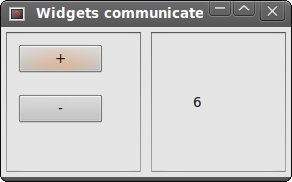
In our example we have two panels. A left and right panel. The left panel has two buttons. The right panel has one static text. The buttons change the number displayed in the static text. The question is, how do we grab the pointer to the static text?
m_parent = parent;
Here we save the pointer to the parent widget of the LeftPanel.
It is a wxPanel widget.
Communicate *comm = (Communicate *) m_parent->GetParent();
comm->m_rp->m_text->SetLabel(wxString::Format(wxT("%d"), count));
These two lines are the most important lines of the example. It is shown, how we get access to the static text widget, which is placed on a different panel. First we get the parent of the both left and right panels. This parent widget has a pointer to the right panel. And the right panel has a pointer to the static text.
In this part of the wxWidgets tutorial, we have created some simple programs.